

























EDI-TVAAccredited network
DGFiP
The VAT stream. A partenaire EDI transmits the file, and only an accredited one may. The DGFiP says any company may apply for that accreditation, including for itself.
Carries 4 filings
Your company brain already holds the closed period, the rate each posting resolved against, and the identity behind every filing. An agent reads it and fills the form.
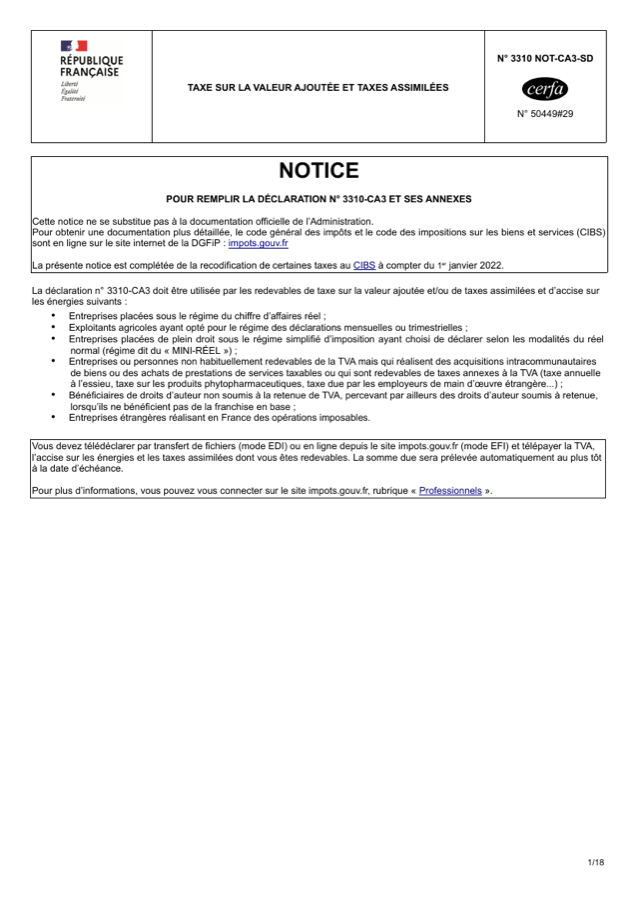
241 filings across seventeen jurisdictions, each one read off the authority that publishes it. Pick one and it opens on the left, page one, exactly as that authority publishes it. The line under each is the tax it settles. Not on the list? Hand the agent yours.
Twenty channels carry the French and American filings, and not one of them is Well's. They belong to the DGFiP, the IRS, a state department of revenue or a network the authority accredits. Beyond those two countries the picture is the same and starker: ELSTER, Entratel, Intervat, Digipoort, ROS, Altinn, TastSelv, FinanzOnline. This is where a machine can plug in at all.
36 channels
DGFiP
The VAT stream. A partenaire EDI transmits the file, and only an accredited one may. The DGFiP says any company may apply for that accreditation, including for itself.
Carries 4 filings
DGFiP
The annual results stream. At the régime réel normal it is the only route: the espace professionnel offers no online entry for the liasse.
Carries 6 filings
DGFiP
Corporate income tax instalments and balance, paid by télérèglement rather than declared.
Carries 2 filings
DGFiP
Online entry by the company itself, in its own espace professionnel. No machine interface is published behind it.
Carries 3 filings
PDP network
The e-invoicing network. A documented API, but only from inside a plateforme agréée the administration has registered.
Carries 3 filings
INPI
Company formalities and the annual accounts deposit. The one French lane in the corpus with an open API on the read side.
Carries 2 filings
Douane
Intra-EU goods and services statements. A teleservice on douane.gouv.fr, with manual entry or a file upload, and no API.
Carries 3 filings
European Commission
The European VAT number check. A keyless service, which is why a counterparty's number can be verified without an account anywhere.
Carries 1 filing
IRS
Federal business returns. Only an authorised e-file provider may transmit, and the IRS runs an application and suitability check before it authorises one.
Carries 7 filings
IRS
Information returns. The portal takes manual entry or a CSV, and IRIS A2A is the machine route beside it.
Carries 2 filings
IRS
Estimated tax, paid rather than declared. A payment rail, not a return channel.
Carries 1 filing
SSA
Wage reporting to the Social Security Administration. Online forms or an EFW2 upload, no published API.
Carries 1 filing
CDTFA
California sales and use tax. A documented programme over SOAP and XML, beside the ordinary online filing portal.
Carries 1 filing
TX Comptroller
Texas sales, use and franchise. An approved transmitter sends the ANSI ASC X12 813 transaction set.
Carries 2 filings
CO DOR
Colorado sales tax, as an XML file submitted through software the department has approved.
Carries 1 filing
FL DOR
Florida sales and use tax, as an XML package from a developer the department has approved.
Carries 1 filing
Streamlined SST
The Streamlined agreement. One return transmitted to each member state's web services, or a certified provider that files as you.
Carries 2 filings
Various
Registrations, permits and the state returns with no published machine route. A person, an account and a browser.
Carries 22 filings
DGFiP
Posted on paper. The initial CFE declaration is the one filing in the corpus with no electronic route at all.
Carries 1 filing
—
Nothing is transmitted. The obligation is to hold the records and produce them on request, not to send anything.
Carries 3 filings
Finanzamt
Germany's single gate. Everything goes through it, and the VAT return must be transmitted in the official dataset over the official interface: ERiC is the documented library that does it.
Carries 16 filings
Agenzia Entrate
Italy's filing channel for the annual returns and the withholding statements. A transmitter registers with the Agenzia and sends the official telematic format.
Carries 12 filings
Agenzia Entrate
The invoice exchange system. Every domestic invoice passes through it before it reaches the customer, which makes it the one tax rail in Europe that sees transactions rather than returns.
Carries 0 filings
AEAT
Spain publishes no blank forms. Every model is filed in the electronic office, with a certificate or Cl@ve, and the web services beside it are documented.
Carries 15 filings
Belastingdienst
The Dutch government gateway. Returns are sent as XBRL under Standard Business Reporting, which is why no Dutch form exists as a sheet.
Carries 11 filings
SPF Finances
Belgium's VAT channel, with Biztax beside it for corporate income tax. Both take a structured upload as well as a screen.
Carries 10 filings
AT
Portugal is the exception in Europe: it still publishes its models as PDFs, and files them through the portal, and mandates SAF-T PT on top.
Carries 16 filings
Revenue
Ireland's single filing service. Mandatory electronic filing covers essentially every business return.
Carries 15 filings
HMRC
The United Kingdom removed the paper VAT return. Filing requires functional compatible software calling the HMRC API, and an unauthorised paper return can carry a penalty.
Carries 9 filings
Skatteetaten
Norway's common gateway for the whole state. The country has no tax forms as sheets at all, only structured submissions.
Carries 7 filings
Skattestyrelsen
Denmark's business portal. Accounting software approved by Erhvervsstyrelsen can file into it, so a machine path exists even where no open API is published.
Carries 10 filings
Skatteverket
Sweden files through the agency's own services, with a file upload route for the periodic statements.
Carries 11 filings
Verohallinto
Finland's tax account. Nearly everything is filed in it or uploaded to it as a structured file.
Carries 10 filings
BMF
Austria's portal, with a documented web service beside the screen for bulk filers.
Carries 10 filings
KAS
Poland's filing channel, now flanked by KSeF for invoices and by the JPK structures that replaced the VAT return itself.
Carries 14 filings
ESTV
The Swiss federal VAT portal. Corporate income tax is cantonal, so there is no single federal return to file beside it.
Carries 7 filings
27 of the twenty carry a machine route. The rest are a person in a browser session, or paper, or nothing at all because nothing is transmitted.
Every one of these ships today. They run in the order the work happens: close the period, sort what has not reached the ledger, settle the identities a form asks about, then fill the sheet.
For a closed French period, Well writes the statutory FEC file. Five gates are checked before serialization starts, then the serialized file is validated again and the statutory filename is resolved from the company SIREN. A failed gate returns its own typed reason, never a partial file.
March 2026, France
Two limits stated plainly: France only, and no full-year file, because year-end close does not ship.
A read of the identity fields Well holds on a company you bill, each one with the source of its value. Well issues no Factur-X, no UBL and no Peppol identifier, holds no PDP registration, and nothing here says an invoice will be accepted. It is the one tax surface in the product you can call from Claude or Cursor.
One customer, read inside one workspace
A register filled the value, or a computed field composed it. Nothing is marked user or ai: the graph records no per-column authorship, and putting a source word on a value nobody asserted would be a claim of its own.
Well reads 112 named tax-ID formats off your documents, from VAT and TVA to EIN, SIRET, and GST. For France and the United States it goes further and canonicalizes the identifier, so one company cannot arrive twice under two spellings of the same number.
Matched on the canonical form, not the printed one
The check you would run by hand, run for you. Three columns per connector, in the present tense, with the loss named where there is one.
| Connector | On the wire | What Well pulls | What survives |
|---|---|---|---|
| Stripe | An invoice carries an array of taxes, one entry per tax rate, each with its own amount in the smallest currency unit. | Well sums the array and converts it, so one invoice yields one tax total. | A single tax amount per invoice. The per-rate split does not survive the mapping. |
| Xero | Each line carries a tax amount Xero computed and a tax type, a token defined by the tenant rather than a percentage. | Well takes the line's tax amount. The VAT rate is pinned to null and the rate reference is left out of the mapping entirely. | A per-line tax amount with no rate behind it. No numeric rate is claimed from a token that is not one. |
| Pennylane | An FEC export endpoint, under a scope Well's grant already holds. | Nothing. The export tools are generated and sit in the catalog with no caller in the codebase. | Nothing yet. The scope is granted and the call is not written. |
Each row is read off the connector's own mapping config and the generated tool catalog, not off a coverage page.
Rate, taxable amount, and tax amount come off the document as it lands, each line tagged with its tax category and scheme. Issuer and receiver tax IDs come with them. A reverse-charge invoice is read as reverse charge, not as zero VAT.
Open any line to read the document it came off
Each rate carries its type, its country, the dates it is effective between, and the two ledger accounts it posts to. Posting resolves the rate for a line from the document date and the country, so the entry routes itself to collected or deductible.
One record per rate, per country, per window
Direction is read from the account a line posts to, never from the sign of an amount. One rate serving both sides of the book still splits into two groups, because the tax leg's account decides which one.
March 2026, France
Reverse-charge lines are held out of the per-rate split. They self-reverse, so both legs stay visible instead of netting to nothing.
VAT carrying no rate reference lands in an unattributed bucket, split by direction, so collected and deductible cannot cancel each other.
The limit, in the same block: this summary is a field of the ledger export response. The builder is not exported, no tool returns it, and no screen in the product renders it.
The filing mandate is held by a person, not by software. In France the cabinet reaches the administration over an approved route and asks for exactly the file Well emits.
Well
Your accountant
“The pitch is not that the cabinet goes away. It is that the month it receives is already closed.”
No. Well does not file anything and does not connect to any tax authority portal. What Well does today is read the tax data off your documents, post it to the right ledger accounts, and export a closed French period as the statutory FEC file. Preparing and filing a declaration is on the roadmap and is not available yet.
Reading tax lines off invoices works on any document, in any currency. Beyond reading, the two countries are not symmetric: France has the statutory export, the VAT account dictionary and SIREN canonicalization, while the United States has EIN canonicalization and little else. Well recognizes tax identifier formats well beyond those two, and no number is printed here because the list is append-only and any figure on a page drifts.
The Fichier des Ecritures Comptables is the bookkeeping file French tax authorities ask for during an audit. Well writes it from a closed period, and refuses to write it until the period is closed, every entry balances, and every account is mapped. You can take a CSV instead if your accountant prefers one.
Not by tax code. Categorization assigns a general ledger category and carries a confidence score you can see and correct. The tax detail comes from a different place: the rate, taxable amount, tax amount, category, and scheme read directly off the invoice, plus the tax rate record that decides which ledger account the entry posts to.
Yes. Well is not a substitute for your accountant and does not give tax advice. It gets the underlying data reconciled, categorized, and exportable so the person filing on your behalf starts from closed books rather than a spreadsheet.
From the sources you connect. Pennylane, QuickBooks, and Xero come in as accounting systems of record; Qonto, Mercury, Revolut, Brex, and Soldo come in as bank feeds. Invoices also arrive by email, by upload, and through the browser extension.
Yes. Tax rates and company identity are records you can edit, and every extracted line opens the document it came off so you can check it against the source before you accept it.
No. No due date is stored anywhere in Well, so nothing can fire. The French VAT deadline is set per taxpayer by legal form, department and SIREN rank, and the only binding date is the one shown in your own espace professionnel.
No. Well sums VAT per rate from the posted journal lines and stops there. It assigns no box number, and nothing in the product renders a declaration.
Connect your accounting and banking sources, close a period, and take the FEC. Free to start.