mcp server

Give AI tools private access to your financial data

Secure, read-only access that powers smarter answers, automation, and reliable insights.

ChatGPT

• Financial data with relationship context • Remote and local servers

Claude

• Financial data with relationship context • Remote and local servers

Cursor

• Financial data with relationship context • Remote and local servers

Make

• Financial data with relationship context • Remote and local servers

Coming soon

N8N

• Financial data with relationship context • Remote and local servers

Coming soon

Zapier

• Financial data with relationship context • Remote and local servers

Coming soon

Use Cases

What happens when AI can reason over financial data

Well turns your financial data into a live context layer for AI agents, enabling workflows that were previously impossible.

Turn AI into a financial advisor

Give AI full context about your business: cash position, burn rate, growth trends. So it can advise, not just report.
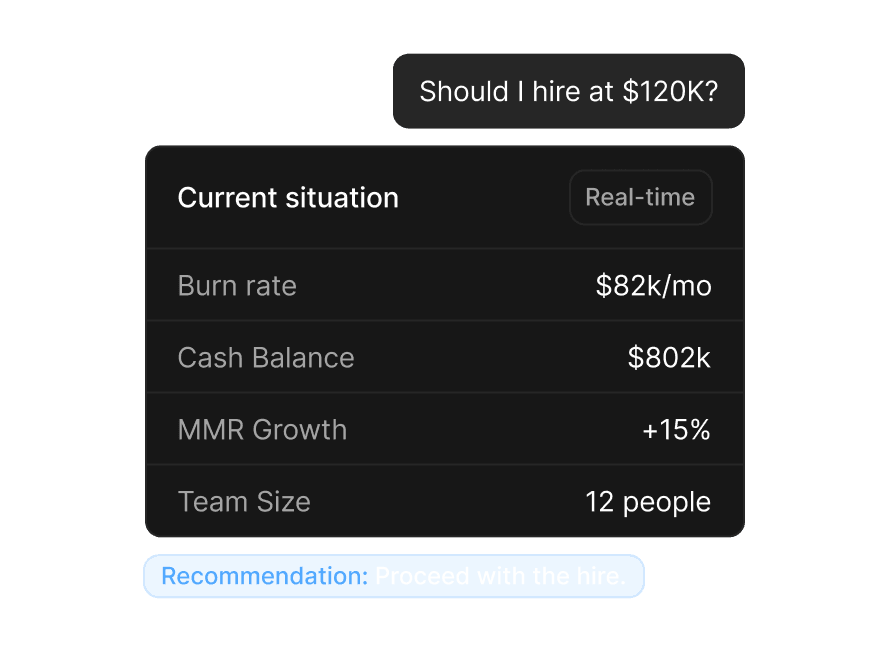
A digital interface shows financial data including a burn rate of 82k per month, cash balance of 802k, MMR growth of +15%, and a team size of 12 people, with a prompt asking about hiring at 120k.
A person questions, "Should I hire at 120K?" above a dashboard displaying financial metrics: burn rate at 82k per month, cash balance of 802k, MMR growth at +15%, and a team size of 12 people, with a statement, "Proceed with the hire," highlighted below.
A financial dashboard displays a real-time overview with a burn rate of 82k per month, a cash balance of 802k, 15% MMR growth, and a team of 12 people, accompanied by a decision bubble asking, "Should I hire at 120k?" followed by "Proceed with the hire."
AI-Powered cash flow forecasting

Saves 2-3 hours weekly on manual cash flow analysis. Enables proactive fundraising decisions 3-6 months earlier.
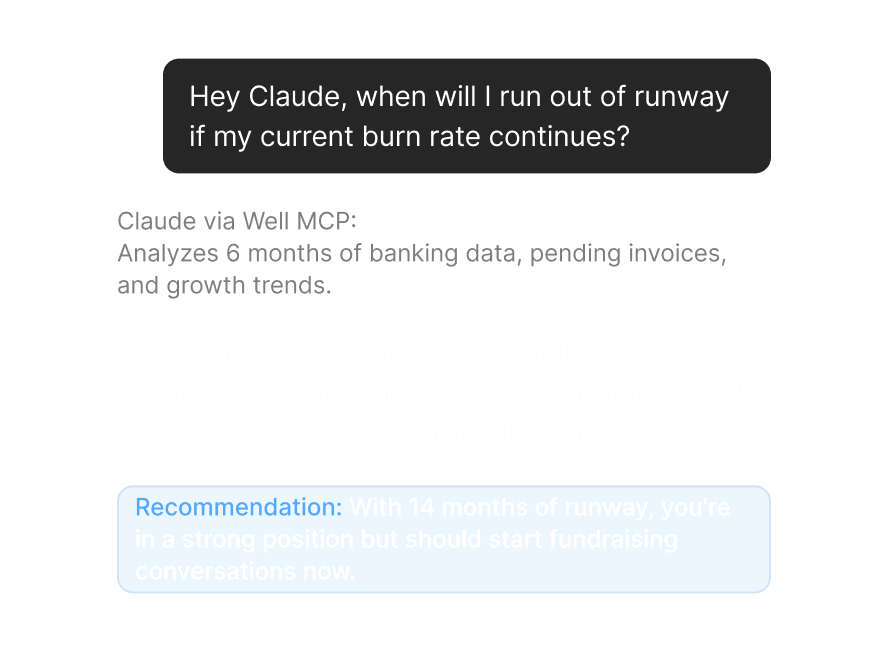
The image displays a chat interface with a dialogue about financial projections, showing concerns over runway and burn rate, advising the recipient of critical cash levels in 14 months, and suggesting to start fundraising conversations.
A dark-themed dashboard displays company retention metrics, featuring a bar chart illustrating monthly churn rates, a table of cohort revenue retention with color-coded percentages, and key performance indicators like logo churn and expansion rate.
Based on financial data, a message predicts critical cash levels in 14 months due to an 8.2K monthly burn and suggests starting fundraising conversations.
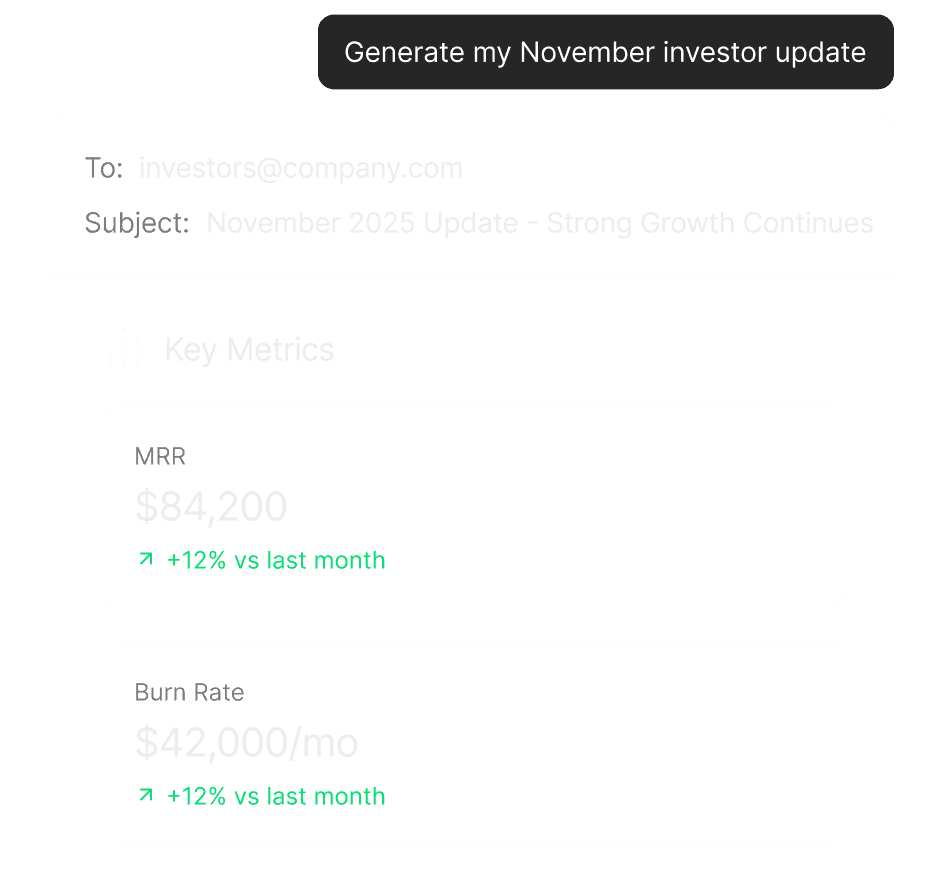
Email interface showing the November 2023 investor update, highlighting key metrics such as MRR and churn rate with a green arrow indicating a 12% increase from the previous month.
The image shows an investor update email displaying November 2023 key metrics, including MRR of 829,296 and QARR of 742,000/mo, both with a 12% increase from last month.
The image displays an email update template for November investor communications, highlighting key metrics with a focus on MRR and Qum Rate, both showing a 12% increase from the previous month.
Investor updates on autopilot

Saves 3-4 hours monthly on investor reporting. Consistent, data-driven updates that build investor confidence.

Smart expense categorization

Eliminates manual expense review. Saves 2 hours weekly on bookkeeping with automatic categorization and context.
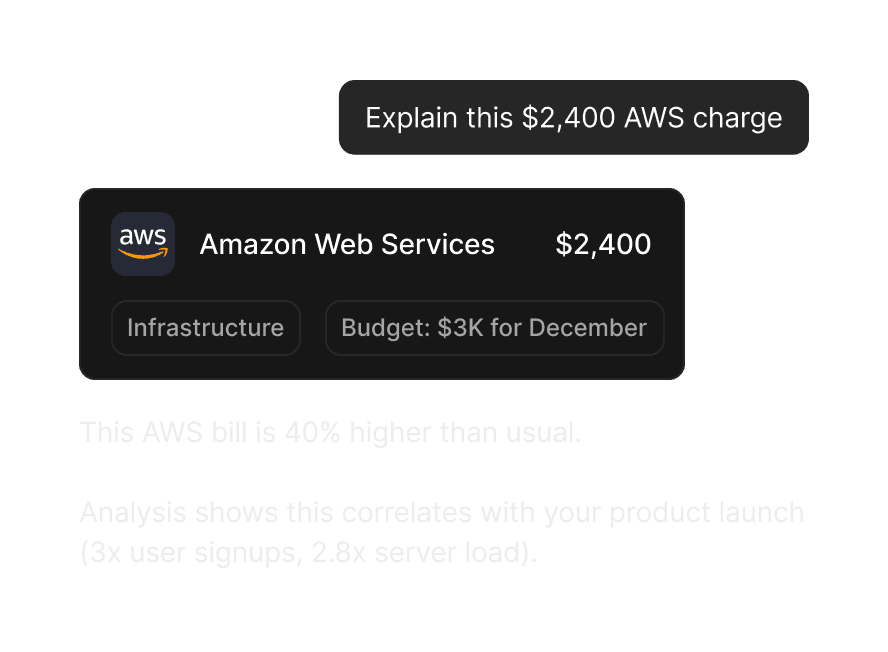
The image displays a notification highlighting a 2,400 charge from Amazon Web Services for infrastructure, noting it's 40% higher than usual, with analysis linking the increase to a product launch resulting in three times more user signups and 2.8 times server load.
A digital interface displays an AWS charge of 2,400, noting a 40% increase compared to usual, linked to a product launch that resulted in three times the user signups and 2.8 times the server load.
This image shows an Amazon Web Services (AWS) billing notification indicating a 2,400 charge for infrastructure, with a budget note of 3,000 for December, accompanied by a context box explaining the bill is 40% higher than usual due to increased server load matching a recent product launch.
Smart financial workflow triggers

Trigger automations on late payments, budget overruns, or cash flow alerts. Reduces manual monitoring by 80%.
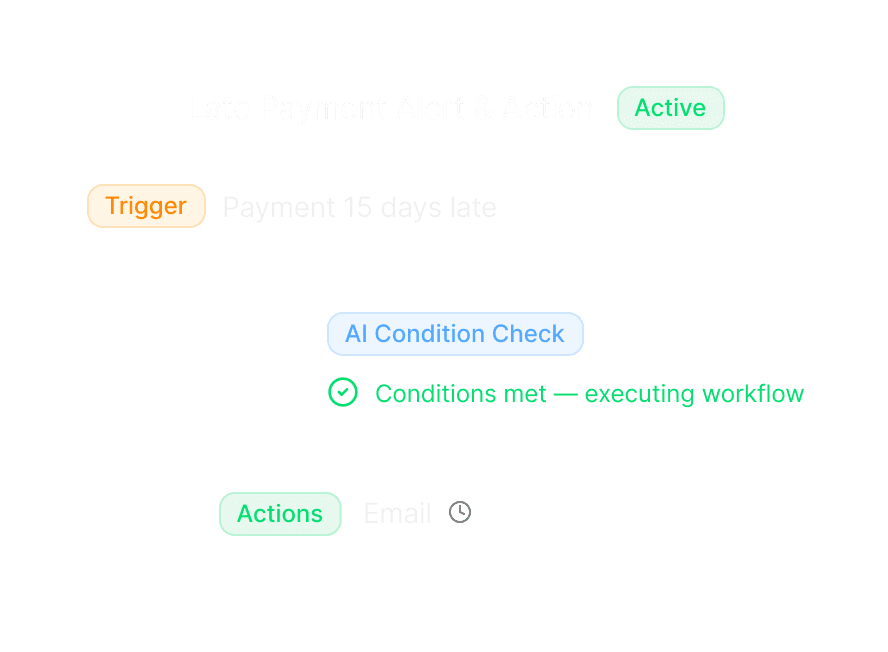
An illustrated flowchart displays a sequence for handling a "Late Payment Alert & Action," featuring a trigger for payments 15 days late, an AI condition check, and an email action.
The image displays a workflow automation system highlighting a "Late Payment Alert & Action," with labels such as "Trigger: Payment 15 days late," "AI Condition Check: Conditions met — executing workflow," and "Action: Email," emphasizing automation in payment reminders.
This image illustrates a flowchart of a late payment alert system, featuring labeled stages like "Trigger" for payments due 15 days late, an "AI Condition Check" confirming execution criteria, and an "Action" for sending emails.
Capabilities

Your financial vault, AI-ready

Live data access

Query real financial data across accounts in real time. No exports, no syncing, no stale numbers. Built on continuously updated, graphed data.

Relationship context

From invoices to companies to payment history. Data stays structured and connected. AI understands relationships, not just isolated rows.

Read & write

Create invoices, update records, and categorize transactions through conversation. Changes are written back instantly and reliably.

11K+ bank connections

Connect to over 11,000 banks and payment providers worldwide. Including Qonto, Revolut, Mercury, Wise, and more.

Secure by default

Scoped API keys, granular permissions, audit logs, and SOC 2 Level 1 compliance. Built to meet enterprise security expectations.

Event-based updates

Stay in sync with changes across accounts and transactions. Designed for reliable updates without relying on real-time webhooks.

Add financial intelligence to your AI stack

Open source, MIT licensed. Install now or explore the docs.